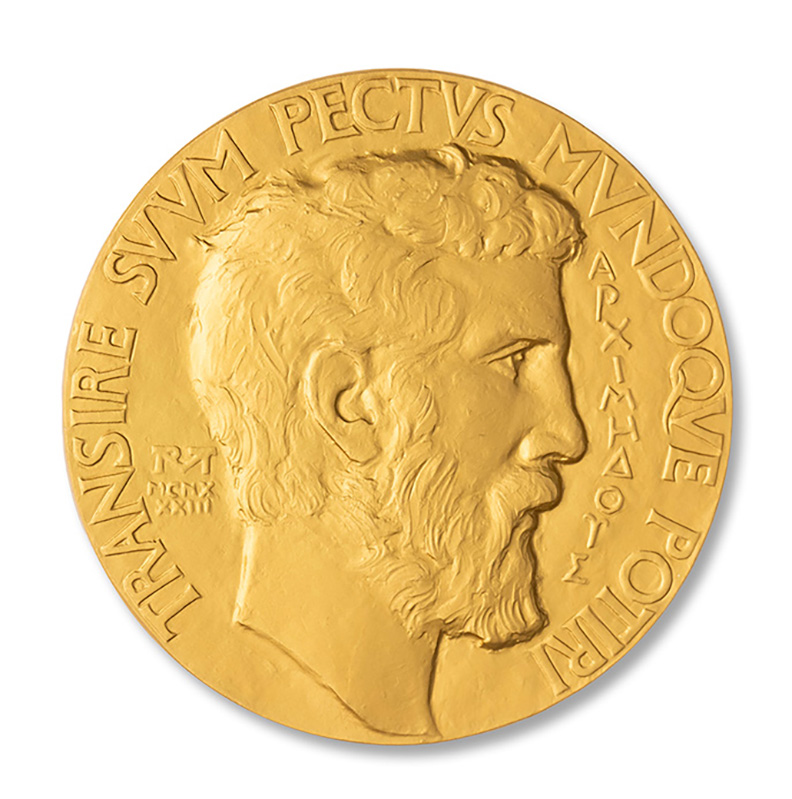
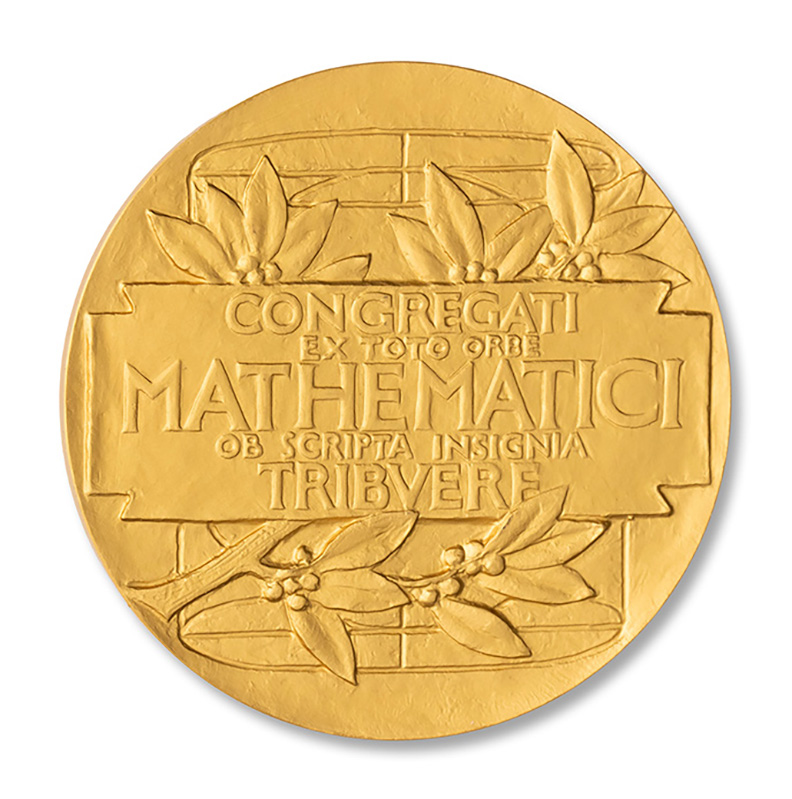
First awarded in 1936, the Fields Medal is one of the most prestigious awards one can receive in the field of mathematics. It is often referred to as the Nobel prize of mathematics, displaying how respected it is, because there is no Nobel prize for math. The medal is awarded every four years by the International Mathematical Union (IMU) to between two and four of the world’s most talented mathematicians for their work in various research topics in the realm of math. Recipients must be under the age of 40 in order to qualify.
The Fields Medal originated from John Charles Fields, who was a professor at the University of Toronto and an organizer of the 1924 International Congress of Mathematics in Toronto. Unfortunately, he had died before the first was able to be awarded. The first two recipients were Finnish Mathematician Lars Ahlfors, who mainly studied Riemann surfaces, and American Mathematician Jesse Douglas, who solved the Plateau problem. The Plateau problem asks whether or not a surface with a minimal possible area in a given boundary curve in a three dimensional space always exists.
Some notable recipients of the Fields medal were Jean-Pierre Serre, a French mathematician who is the youngest person to receive this award so far at the age of just 27. He studied algebraic topology and homological algebra. Additionally, Maryam Mirakhani was the first woman to receive the Fields medal. She received the prize in 2014 for her work in Riemann surfaces. This year, 2026, marks the 20th ceremony for the Fields medal. The four winners this year are Yu Deng, John Pardon, Jacob Tsimerman and Hong Wang.
Yu Deng
A Chinese mathematician and a professor at the University of Chicago, Deng is awarded for his work in partial differential equations. He earned his PhD from Princeton University in 2015 and derived the Boltzmann equation, one of the most important equations for statistical mechanics and kinetic theory. It describes how a system of particles moves or changes over time when they are not in thermodynamic equilibrium. A few of his other achievements include studying and deriving equations for wave kinetics and solving a famous 125-year-old mathematical physics problem called Hilbert’s Sixth Problem.
John Pardon
John Pardon is an American Mathematician who works as a professor at Stony Brook University at the Simons Center for Geometry and Physics. He studied geometry and topology, and won the medal for his work in these fields. Specifically, he was awarded for solving problems in symplectic geometry and Fukaya categories. He proved the famous 20-year-old MNOP conjecture and also had other achievements in solving the Hilbert-Smith Conjecture and Gromov’s Knot Distortion Problem when he was only an undergraduate at Princeton University.
Jacob Tsimerman
Jacob Tsimerman is a Canadian Mathematician who studied at the University of Toronto and Princeton University and is currently a professor at the University of Toronto. He studies arithmetic and complex algebraic geometry and focuses his research on number theory. Additionally, he is the Scientific Director for the Mathematical Artificial Intelligence Safety Institute, which is a nonprofit that is working to develop “mathematical foundations for the safety of powerful AI systems.” Along with being a Fields medal recipient, he also won the 2022 New Horizons in Mathematics Prize, the Ostrowski Prize and the John L. Synge Award.
Hong Wang
The first Chinese woman and the third woman in the history of the Fields medal to receive the award, Hong Wang studied at Peking University for her Bachelors degree and at the Massachusetts Institute of Technology (MIT) for her PhD. Currently, she is a professor at New York University. She studies harmonic analysis and geometric measure theory. She also solved the Kakeya problem in three-dimensions, which earned her the Fields medal. Some of her other achievements include winning the Salem Prize, the Ostrowski Prize, the Antonio Ambrosetti Medal, the Sadosky Prize and many others, showing how important her studies are to the field and growth of mathematics.